Focus Area · Last updated June 2026

Creator Economy Strategy for Streaming Platforms

How streamers can compete with YouTube by attacking the viewer jobs YouTube can't redesign around.

Executive Summary

YouTube caught Hollywood by surprise, becoming the biggest TV network in America — 13.2% of all TV viewing, more than any single streamer, and built on free creator content. The streamers chasing creators in 2026 are largely doing it wrong: signing a few big names and hoping it works. The real opportunity is using YouTube as the world's largest A/B test on what creator content viewers want in the living room, then building a product around the viewer jobs YouTube's scale can't redesign around. This is one way I think about creator economy strategy in streaming — and it's the lens behind the work I've led at Twitch, Snap, and Defy.

Need help building your creator strategy? Let's get into the specifics.

Work with Chris

Behind closed doors in 2018, people in tech and media started to whisper about one very unusual secret piece of market research. While the streaming wars were at their peak -- Netflix, Warner Bros. Discovery, Amazon, and Disney were spending billions on original content -- people were doing something else when they turned on their TVs. Most people in front of their living room TVs weren't opening a premium streaming app, not even Netflix... instead they were opening YouTube1. The totally free service, that also gets its content for free from creators, was actually winning the streaming wars. A few years later, this secret was made prominently public when Nielsen's The Gauge started publicly reporting on it in May 2021.

13.2%
of all US TV viewing — more than any single streamer or network
Nielsen, The Gauge
500 hrs
of new video uploaded to YouTube every minute
Tubular Labs
10+ yrs
YouTube has been optimizing for the living room ahead of Hollywood

And even though this big news debuted 5 years ago, we're at an inflection point where this strategic problem is finally front-and-center. A number of economic and competitive dynamics have forced the streamers to find ways to compete with lower content costs and they've set their sights on YouTube:

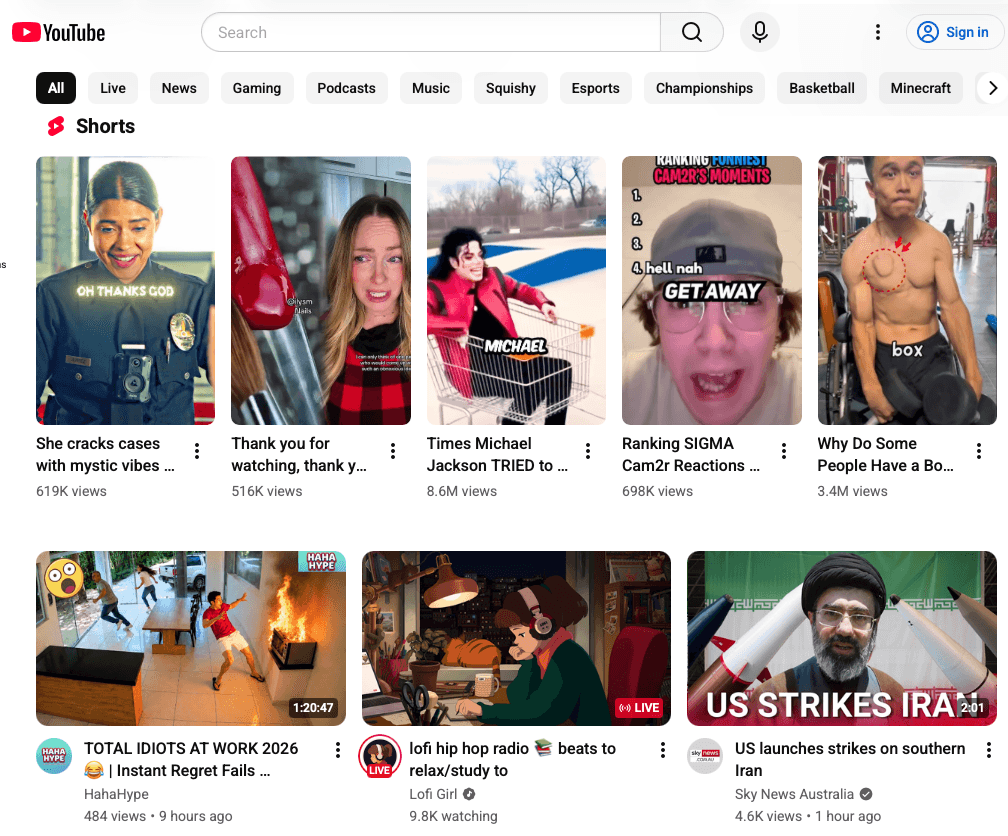
YouTube web home page showing a Shorts row of vertical video thumbnails above a grid of mixed-genre video tiles — news, gaming, music, podcasts — each with engagement counts.
This is what the largest TV network in America actually looks like...

The battle for creators is really just a battle with YouTube

This is totally uncharted territory. Building original content around creators has been happening for at least a decade with mixed results. What's different now is that mainstream Hollywood is competing with YouTube on the same turf: before, the fight was between cable and mobile phones; now, every major media company has some foothold in the living room, just one arrow key away from YouTube.

But this is going to be a much harder battle than anyone is prepared for. While Hollywood was fighting with each other, YouTube was slowly and methodically building a living room business with several compounding advantages:

  • Content in the right format. YouTube diversified way past short-form and has been incentivizing creators to make mid- and long-form content since 2012. And while many thought YouTube would have to play catch-up with mobile vertical content, the tables have turned in the living room: TikTok and Instagram have almost no 16:9 library, and YouTube has the largest one ever assembled.
  • Living room UX and personalization. YouTube is one of the first video platforms to have a true living room experience. As smart TVs and consoles arrived, YouTube was first to market with bespoke apps (back when I was at Revision3, it was really just us and them!). They've been learning about living room consumers for more than a decade, and more importantly, so have their machine learning algorithms.
  • Individual accounts. Since YouTube started on web and mobile, people already have profiles and accounts there. YouTube already knows your viewing habits, subscriptions, and watchlist. When a viewer signs up for the other streamers, those platforms have a cold-start problem and are learning the viewer from scratch.
  • Offering for Kids. YouTube has maintained a separate Kids app since 2015, and a 2019 FTC ruling ironically forced them to spend even more resources on bespoke children's content and products.
  • Multi-app ecosystem. YouTube TV and Google TV (Google's TV operating system) don't count toward Nielsen's Gauge numbers for YouTube. But as anyone who has searched for content on those surfaces knows, they are valuable front doors that drive traffic back to the main free YouTube app. They are also fronts to build complementary competencies in Sales and GTM.
YouTube's top filter pill bar showing the tabs: All, Live, News, Gaming, Podcasts, Music, Squishy, Esports.
The pill bar at the top of YouTube sessions gives you a peek into the diverse and dynamic “verticals” they serve.

The obvious theme here is just how long they've been working on putting creator content on your TV. A decade-plus head start, with a product, audience graph, and creator pipeline that all reinforce each other.

What YouTube really does for viewers

This could seem insurmountable. Instead of thinking about YouTube as a competitor, let's think about the viewer, where all great content strategy starts.

What does all this creator content actually help YouTube accomplish? My favorite way to think about creator content in the living room is to back into a jobs-to-be-done framework. People think of YouTube generically as a boredom-killer helmed by creators, but that's pretty superficial. Think a layer deeper about what problems users "hire" YouTube videos to solve. From that angle, YouTube isn't a creator platform. It's a living room superapp:
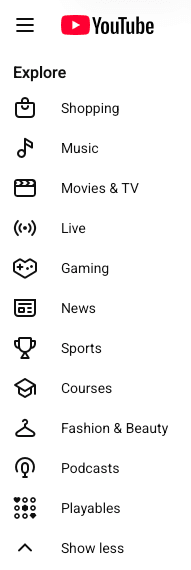
YouTube's Explore sidebar listing the verticals: Shopping, Music, Movies & TV, Live, Gaming, News, Sports, Courses, Fashion & Beauty, Podcasts, Playables.
YouTube's own Explore menu reads like a jobs-to-be-done list.
  • Helps me stay informed with news and podcasts
  • Helps me get healthy with fitness instruction
  • Improves my home with DIY videos and inspiration
  • Saves (or makes) me money with advice and instruction
  • Educates my family with free lectures, classes and tutoring
  • Helps me relax or fall asleep with music and meditation
  • Helps me find community with others interested in my niche hobby (magic, anime, crafts)

And we could keep going for dozens more.

It would be very hard to dismantle all of the synergistic ways that YouTube serves consumers. You can't out-YouTube YouTube! But by breaking the platform down into discrete viewer jobs, suddenly there are many fronts on which you can attack for market share.

From this piece

You can't out-YouTube YouTube!

Which front you pick is going to depend on the streaming service. That's where we'll head next.

Find the viewer jobs where YouTube's scale becomes a weakness

The next question on the way to a creator strategy:

which YouTube living-room use cases are structurally vulnerable to us?

Answer that by looking at areas where your platform has an advantage and YouTube's scale creates weakness.

You can use a 2x2 like this to help visualize it. I've temp'd in generic "streaming platform" as an example:

StrengthsWeaknesses
YouTubeConcede these. Scale, recommender, free creator supply, account graph.Attack these. Generalized UX, no trust layer, hostile ads, no editorial POV.
Your streaming platformBuild on these. Trusted brand, purpose-built UX, premium production, IP rights.Shore these up. No creator pipeline, cold-start viewer, tiny library, slow content cycle.

The interesting strategy lives in the diagonals: pair one of your strengths against one of YouTube's weaknesses, and you have a wedge.

Take breaking news. YouTube is not an ideal product for it. I'm sure there are very smart people there thinking about news. But because YouTube has to be a generalized product for all-things-video, they can't design and build around that isolated use case. Their scale means there's a lot of untrusted content there. And in a breaking news situation, it's pretty hard to find truly moment-to-moment coverage. How could CNN or X/Twitter -- would-be streaming platforms that already own a similar immediacy on desktop -- better serve breaking news moments in the living room? You could even do it in partnership with curated creators.

YouTube's News experience page showing a hero row of 'News about Iran · US' video thumbnails, a 'Latest news posts' row of social-style cards, and a 'Live now: News' row featuring NBC News Now, Dateline, and AP live feeds.
YouTube's News surface is still just a grid of videos with thumbnails and view counts.

Or consider sleep and meditation. YouTube is the largest library of sleep content in the world, but the product itself is... hostile. Mid-roll ads kick in over a soothing forest sound. Autoplay rolls you into another unpredicatable video. Calm and Headspace have built billion-dollar businesses by removing exactly those issues. A streaming service with a clean, full-screen, ad-light wind-down product could own that hour of the evening without ever picking a fight with YouTube head-on.

Or fitness instruction. Peloton, Apple Fitness+, and Nike Training Club have shown that purpose-built workout experiences (timers, heart rate overlays, structured progression) beat YouTube's open-ended buffet for people who actually want to follow a program. A streaming platform that wraps creator-led workouts in a real coaching layer is attacking a high-intent job YouTube can't easily redesign around. Several big fitness influencers have proven this on their own.

And those aren't even the most inventive ones. You can run this exercise on every single use case, including very niche ones. Each one is a wedge.

YouTube's free experiment is your testing ground

Why all this obsession with YouTube?

We've covered how YouTube's first-mover advantage built their dominant market share, and how creator content benefits living room consumers. So what is YouTube's "creator economy strategy"? Ironically, there isn't really one. Their strategy has been to lower the barrier of entry to make content across the board: free uploads, audience-driving algorithms, monetization tools. That's not a creator content strategy in the traditional sense. It's not a portfolio of investments like the other streaming platforms. It's more like a spray-and-pray approach: at YouTube's scale, uploads play survival of the fittest, and the creator economy works itself out into a diverse group of creators doing those "jobs". Their corporate strategy team isn't picking video verticals to target; by tackling all of video, it happens on its own.

That giant scale turns out to be a huge advantage to non-incumbents.2 Creators are already experimenting in every type of content every day, to the tune of 500 hours uploaded every minute. And YouTube is expertly matching them with audiences. We get to hatch our strategies after that, with the benefit of the experiment being already underway. Your zero-to-one problem just got that far past zero. In fact, you can go ahead and poach creators right from YouTube who already have product-market fit.

That's the move. Don't fund unproven creator concepts and hope they land. Use YouTube as your live A/B test:

  1. Pick the viewer job. Use the jobs-to-be-done lens to find a use case where you have a structural advantage and YouTube has a structural weakness — news, sleep, fitness, kids, finance, community, whatever fits your platform.
  2. Find creators who already have PMF in that job on YouTube. They've already proven audience demand at scale. You don't need to guess.
  3. Wrap the creator in product YouTube can't or won't build. You build a product or complementary content offering that pairs with those jobs. The creator brings content and audience; the streamer brings a trusted brand, product or other moat.

From there, you can migrate audience, negotiate some exclusivity, work on a flywheel and more... but that's the beginning of a real content strategy.

Nobody is taking out YouTube. But you also don't have to. YouTube is running the world's largest, free, real-time market research project on what creator content America wants to watch in the living room. Pick your target, source creators and build the offering around them that YT never will.


Footnotes

  1. This secret actually came with two punchlines: when most people opened their TVs, they were either opening YouTube or switching to a gaming console. The gaming fork in that road is slightly less surprising and a whole other story.

  2. We thought this way at Twitch too: why try to build a short-form discovery engine to rival YouTube and TikTok... creators are already uploading clips there, they get discovered, and then come over to Twitch where our product uniquely enables live streaming.

Creator Platforms I've Worked With

  • Twitch
  • Snap
  • Instagram
  • YouTube
  • TikTok
  • Facebook
Project Archive

Work from the archive

Project

HackCollege: Podcasting, video and the early creator economy

HackCollege was a video podcast, blog and web show about technology and lifestyle for college students. In 2007, my co-founder Kelly Sutton and I noticed two mega-trends: 1) this was the first generation of students leaving home who were more apt to Google something than call their mom 2) even though they were strapped for cash, they had world class broadband connections piped right into their dorm rooms. Search, video and podcasting combined to ride those waves of growth and whitespace. We were able to establish an authoritative “life hacking” website that was loyally bookmarked and searched, becoming one of the top 1000 Alexa-ranked sites on the internet. That journey led me to global tech conferences, getting recognized in the airport, writing for Wired Magazine, Barack Obama following me on Twitter and eventually an exit to HigherEducation.com, now a part of Red Ventures (Bankrate, Lonely Planet). Growing a new media business through audience analysis is part of my DNA and informs my approach to business: entrepreneurial experimentation and working backwards from the customer. A College Content Strategy: Video Podcast, Search and Early Social Media We built HackCollege as a multi-format brand before that was really a strategy… motivated mostly by our being film students and obsessing about getting video out on the web. Building a search-friendly blog combined with audio and video turned out to diversify discovery and monetization. Practical blog posts based on our real experiences captured high-intent search traffic (“how to fix dorm WiFi,” “cheap textbooks,” “best note-taking apps”), while longer-form evergreen guides compounded over time through SEO…

Read the full project
Project

Talks & Lectures: VidCon, CES and LMU School of Film & Television

VidCon Industry Panel: Understanding the Influence Between Brand and Content Creators I moderated a standing-room-only panel at Vidcon about running effective influencer marketing campaigns with executives from Samsung, Taco Bell and Captiv8. I cannot overstate how packed this room was, it was overflowing. I also got to meet Peter Kafka right before! Description: When brands engage creators with an interest in doing an “Influencer Program,” there are ways to make that process seamless and simple. But that’s easier said than done. Often, expectations are misaligned. Budgets are random. And execution is clunky. In this session, we will explore the best practices of an Influencer Program as we dig into the 5 core components (Authenticity, Audience, Content, Quality and Measurement), highlight successful (and unsuccessful) influencer programs, and provide a template for launching an influencer program from start to finish. attendees will walk away with smart questions to ask a content creator as they enter a partnership, learn how to package and price a campaign, and gain comfort in and excitement for the Influencer Opportunity. Digital Media Courses at LMU School of Film & Television Over the years, I have taught 4 semesters of bespoke digital content production classes at Loyola Marymount University’s School of Film & Television. Introduction to Digital Platforms Description: Digital platforms have not only come to dominate the entertainment industry but companies like Google, Facebook and Amazon are among the most powerful and valuable businesses in the world. This introductory class will give students an overview of the most significant digital platforms in media…

Read the full project
Project

Thursday Night Football on Twitch – Programming Streaming Live Sports For Audience Growth & Ratings

As Head of Programming at Twitch, I led the Thursday Night Football program on Twitch. Thursday Night Football is a $1B per-year commitment by Amazon and nowadays we take for granted what a gamble that was: will that (mostly older) Thursday Night Football demo navigate within their smart TV, download Prime Video and figure out how to stream the game there? A little more context for you non-sports fans: I think it’s fair to say that Thursday Night Football is the weakest NFL game of the week… it’s the newest package in the franchise, the timing is weird during the week and it’s usually a pretty random matchup. The ratings had to meet or exceed the viewership on broadcast to prove to the world that streaming sports could work. Challenges Promoting and Merchandising Live Streaming Sports Incredible athletes. Dramatic finishes. Your finest memes and co-streams. Thursday Night Football returns to Twitch starting September 26 with Eagles v Packers. Check out the full schedule and who’s lined up to co-stream: https://t.co/INmrWSe0EB pic.twitter.com/HFhOQP7Hrb — Twitch (@Twitch) September 6, 2019 At Twitch, promoting and merchandising a live sports broadcast was even slightly more of a hot potato for two reasons: Because the main home of TNF was on Prime Video (a widely available but ultimately paywalled service) we didn’t want to publicly make it known that the game could be frictionlessly watched for free on Twitch . We made special arrangements for Twitch to be included in Nielsen ratings — we want to gather Twitch audience that might not have otherwise tuned in…

Read the full project
Project

TikTok’s Top 40 Trends of 2020 in a Curated Global Livestream

I developed and produced TikTok’s New Year’s Eve Countdown, hosted by Brittany Broski and Lil Yachty in 2020. This was a groundbreaking project in many ways: Biggest single-day TikTok live stream reaching over 7 million viewers Streamed live, globally in nearly 100 countries, for 4 hours leading up to the NYE countdown TikTok’s first internally commissioned outside-production live stream, particularly at this scale Featured >300 individual creators in musical performances, interviews, sketches and countdown montages Scaled curation of thousands of videos with cross-functional coordination In order to yield the >300 creators who made the final cut we had to curate and reach out to nearly 1,000 — and we only had 6 weeks before the show aired. I hired a team of curators who collected and labeled video and creator candidates by theme and trend. As each were pitched and approved by creative teams, we slotted them for outreach via Strategic Partnerships which looped the conversations back to our team to negotiate and finalize agreements and delivery.

Read the full project
Project

Creator Original Talk Show – Drama King with Kingsley

The first original talk show I made with a creator was Drama King, hosted by the incredible and iconic talent, Kingsley . We made 40 episodes and were lucky to book incredible guests: Quinta Brunson King Bach Smosh Shane Dawson iJustine Bella Thorne Grace Helbig Roi Wassabi Flula Miranda Sings Glozell Lucas Cruikshank Timothy DeLaGhetto DeStorm I served as showrunner, Executive Producer and Creative Director for Defy Media.

Read the full project
Project

Scaled Creator Education & Building Playbooks: Global Enablement for Platforms and Media Brands

TwitchCon, the annual conference for streamers, is one place we held scaled education lectures, workshops and roundtables for creators. Education isn’t just part of my work with entertainment and media companies; it’s a long-standing personal passion. I’ve taught at universities and founded a college self-help company that ultimately exited to Red Ventures. Creator education at scale is a different beast than creator support or creator marketing. At Twitch I helped run programs that touched thousands of creators globally in personal and localized webinars and IRL at conferences. I’ve also done versions of this for Instagram, Disney, and inside the creator teams at Defy and Sony. Scaled education crosses Product, PMM, content, ops and data science; it’s complex. Done well, it compounds product adoption and creator outcomes. Done poorly, it’s a PDF nobody reads. Creator education programs spanning live, vertical and VOD I’ve worked on many of the largest scaled education playbooks in the creator economy, including core programs for Twitch, Instagram, YouTube and Disney. Twitch Creator Curriculum My team at Twitch launched and developed the Twitch Creator Curriculum, a 5-part webinar series spanning channel growth strategies, stream engagement, community-building, improving monetization and leveraging brand. This comprehensive advanced streaming course was >250 slides and 8 hours of content. We presented it live at TwitchCon and globally through webinars in 6 different languages with complete localization. The project went from concept to complete GTM in 6 months in 2021. YouTube Creator Playbook The original YouTube Creator Playbook for Media Companies was even handed out in print! I contributed several case studies that…

Read the full project
Project

A Creator Original Based on Google Earth for YouTube

I developed and co-executive produced Pin Drop, a YouTube Original based around science creator and communicator, Veritasium . Google Earth is an interactive product that allows you to visually fly through any part of the world. Pin Drop investigates the mysterious images we can see from above by visiting them on the ground. Like these electric blue ponds that make a chemical that’s critical to human life…

Read the full project
Writing

Deeper on the topic

Industry Commentary

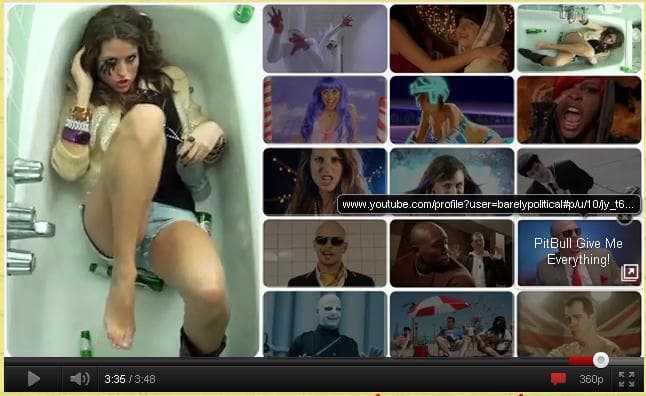
YouTube’s Secret New Related Videos Design

YouTube is occasionally showing users a new, re-designed related videos grid. You won’t see it at the end of every video (YT is probably just testing it), so here’s a peek. I’ve seen lots of eye-tracking studies on video sites and users BURN the frame where the video is, so end cards like this get a really high click-through-rate. This is valuable real estate. Notice that share functions are much more hidden than before. YouTube is trying to encourage users to engage in longer viewing sessions — focusing them on watching another video rather than sharing, replaying or embedding. But sometimes giving users too many choices like this results in a poorer aggregate CTR, so we’ll see where this goes. YouTube recently acquired Next New Networks and folded them into…

Read full post
Industry Commentary

How Paranormal Activity Started a New Category in Horror

I recently resurrected an old presentation I gave at Twitch and shared a new version with students in Justin Winter ‘s AI Producing class at LMU. This post is a recap! 15 years ago, Paranormal Activity was released, just in time for Halloween in 2009. It was a viral phenomenon and the highest grossing horror movie of the year. The momentum was so powerful that Paranormal 2 and 3 became the highest grossing horror films in 2010 and 2011. This was an industry-shifting movie for many reasons (the beginning of Blumhouse’s low-budget model and the marketing campaign 1 among them), but I want to focus on one unexpected upshot you won’t see unless you dig into the data like I have: Paranormal Activity met very unique conditions in the…

Read full post
Screenshot of Matthew McConaughey in True Detective
Industry Commentary

The Most Important Thing About Creating Content Or: The Secret to Great Content Strategy

Have you ever watched a show and thought this show is perfect for me ? Maybe a movie? The last time this happened to me was True Detective on HBO. It had a cast I love, a plot that intrigued me and cinematography I admired. That seems like a lot of expensive reasons to like a show: world class writing, acting and filmmaking! People love all sorts of content. What do they all have in common? Some of my colleagues would say story, many would say character. But then how would you explain that some people hate a certain book… even though it’s a great story? How would you explain BuzzFeed or ESPN? How would you explain a stand-up comedian? Story and character don’t really explain those things… especially not…

Read full post
Future Outlook

The streaming wars are about to look very different. Within three years, the successful streamers will be the ones who treated creator content not as cheap filler but as new business lines — picking a small number of jobs where YouTube is structurally vulnerable and building products around them. Expect to see streamers acquire or incubate creator brands in large numbers. Expect more clean, ad-light "vertical" apps (in more ways than one!) that solve one genre or job. And expect Hollywood's relationship with creators to mature from talent deals into something closer to long-term partnership. Because the creators who win the next decade will be the ones with both social media reach and a streamer-grade product layer.

Frequently asked

Why are streaming platforms suddenly chasing creators?
YouTube secretly stole the largest share of US TV viewing — 13.2% as of 2026 per Nielsen's The Gauge — while Hollywood was busy in-fighting over traditional media. Amazon, Netflix, Tubi, Roku and Instagram have all responded in the last 24 months with creator-led originals, podcast video deals, and connected-TV apps. The creator economy isn't a side bet anymore; it's the front line of the streaming wars.
What is YouTube's creator content strategy?
Broadly speaking, YouTube doesn't have a content strategy in the traditional sense. A Hollywood distributor or streaming service would pick and choose their investments as a content strategy. Instead, they invest in a product that enables the entire video ecosystem. Then, based on which content sinks-or-swims in finding audience, an organic content strategy emerges.
Why use YouTube as a benchmark instead of TikTok or Instagram?
YouTube is the only short-and-long-form library that has been optimized for the living room for over a decade. TikTok and Instagram have almost no 16:9 library, no mature TV apps, and no account graph in the living room. YouTube is also running the world's largest live A/B test on what creator content America wants. It's like a totally free and open talent farm.

Looking for a partner on this?

Work with Chris